
Checking Criminal History in Montgomery County
No single public database contains a complete Montgomery County criminal history. New York's WebCrims is the practical first stop for pending criminal cases and future appearances in participating courts. It can be searched by defendant name, case identifier, or court calendar. The result is a court status and calendar tool, not a fingerprint rap sheet. Closed, new, sealed, or locally held matters may be absent.
Start with a full name and likely spelling variants. A date of birth, docket number, arrest date, municipality, or appearance ticket can separate similar names and point to the right clerk. Montgomery County has County Court plus city, town, and village courts, so the place of arrest often matters as much as the person's name.
- Search WebCrims by name or case number, then note the court, docket, charge, status, and next date.
- Confirm the result with the named clerk. Felony files normally lead to County Court and the County Clerk in Fonda.
- Call Montgomery County Corrections for current county custody; use DOCCS only after a transfer to state prison.
- Ask the arresting police agency for its incident or arrest report. Those papers do not move into the court file.
- Use DCJS Personal Record Review when reviewing your own fingerprint-supported statewide New York record.
Why Montgomery County Records Split
Montgomery County records live in several buildings because each office creates a different part of the case. The New Montgomery County Courthouse at 58 Broadway in Fonda holds County Court, while the County Clerk keeps filed Supreme and County Court records. Across the river corridor, the Sheriff and Correctional Facility at 200 Clark Drive in Fultonville hold sheriff reports and county booking material. The County Office Building at 64 Broadway houses the District Attorney and Probation.
The county government directory shows how these public offices fit together.
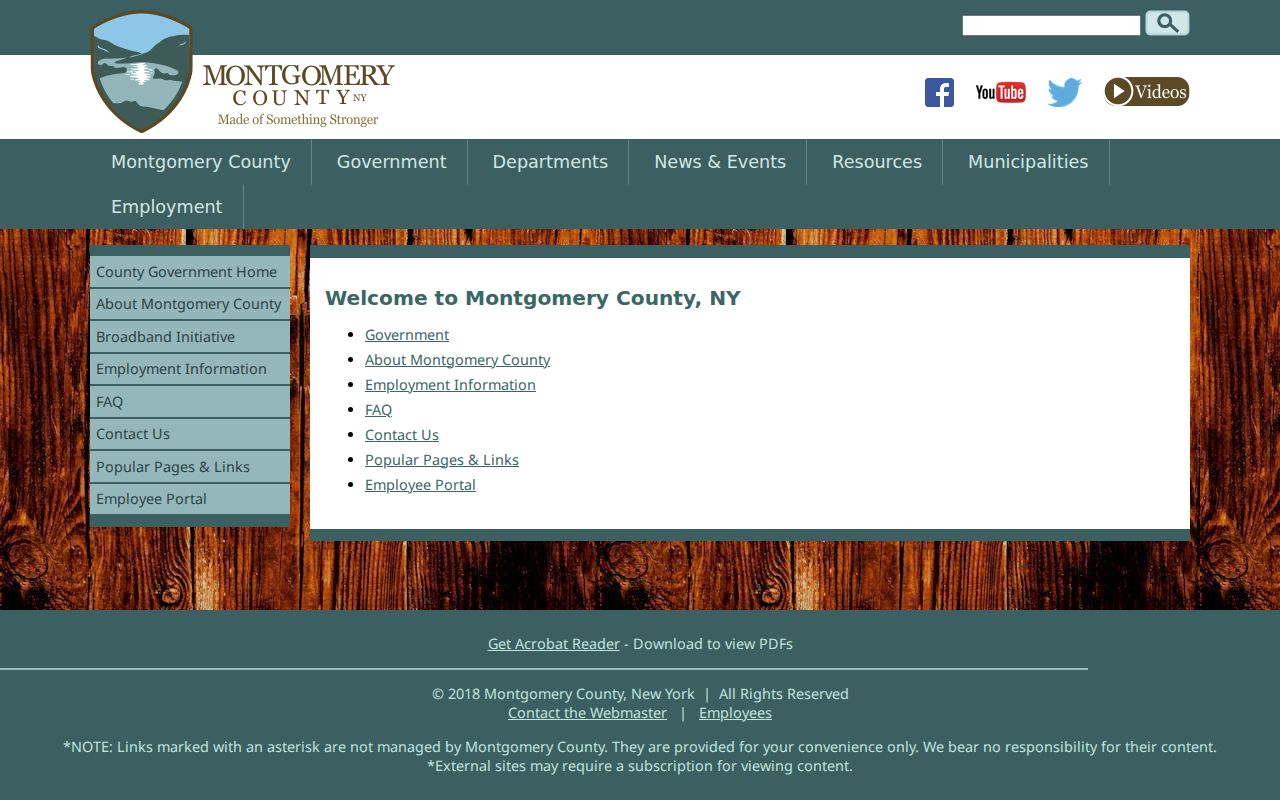
The directory is a routing tool. It does not replace the record kept by a court clerk, police agency, jail, or state repository.
County Court
58 Broadway, Fonda, NY 12068
518-853-3834
Felony cases and shared misdemeanor jurisdiction
County Clerk
Fonda county complex
518-853-8111
Filed Supreme and County Court records
Sheriff and Jail
200 Clark Drive, Fultonville, NY 12072
518-853-5500
Reports, booking records, and FOIL requests
New York Official Background Checks
The New York State Division of Criminal Justice Services, or DCJS, is the state repository for fingerprint-supported criminal history. It does not offer a public name search for another person's rap sheet. Its Personal Record Review lets the subject, or an authorized attorney, request a suppressed or unsuppressed version. A suppressed response leaves out sealed or suppressed material. An unsuppressed response includes the specified sealed categories and youthful-offender information allowed for the subject's review.
The official DCJS page shows the personal-review route and its limits.
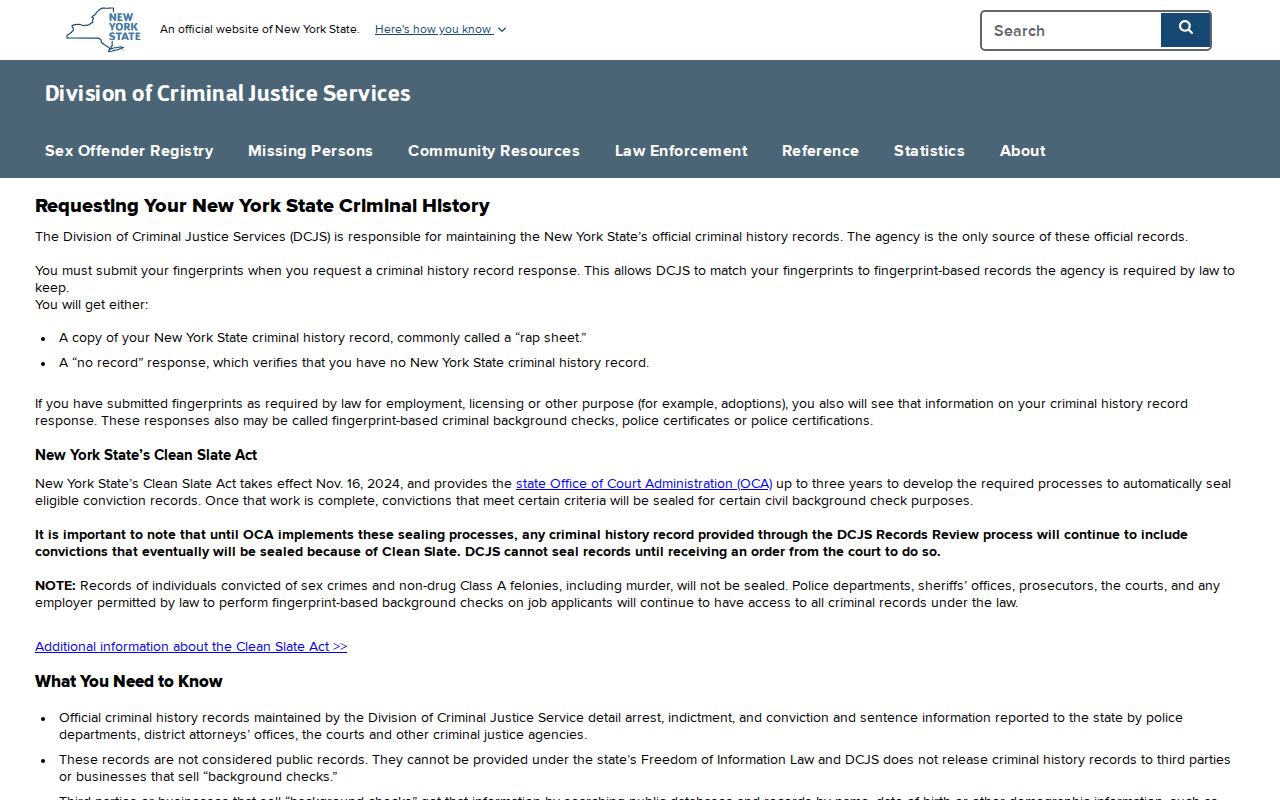
This fingerprint process is the sound choice for checking your own New York record and whether a disposition or sealing order reached the repository.
| Channel | Current stated cost | Scope |
|---|---|---|
| DCJS suppressed review | $17.50 fingerprint processing | Subject's New York record with sealed material omitted |
| DCJS unsuppressed review | $17.50 fingerprint processing | Subject's fuller New York repository record |
| FBI Identity History Summary | $18 direct to FBI | Subject's fingerprint history from FBI contributors |
| Local clerk copies | Ask the clerk | Individual Montgomery County case documents |
Montgomery County WebCrims Limits
WebCrims is most useful when a Montgomery County case has a future court date. It accepts a defendant name, a case or docket identifier, or a criminal court and calendar date. The court shown in the result is vital. A felony complaint may begin in a local court before an indictment moves the matter to County Court. A misdemeanor may stay with Amsterdam City Court or one of the town and village justice courts.
| Search field | Use | Practical check |
|---|---|---|
| Defendant name | Name mode | Try exact spelling and verify the court and date |
| Case or docket number | Identifier mode | Keep punctuation and leading zeroes |
| Court | Calendar mode | Select the specific criminal court |
| Date | Calendar mode | Use the scheduled calendar date |
A blank result is not proof that no Montgomery County record exists. The matter may be closed, too new, sealed, maintained by a court outside the portal's scope, or indexed under another spelling. New York Courts says the specific court enters and corrects its data, so a disputed result should go to that clerk.
Criminal Record Types
Montgomery County criminal records describe stages, not one fixed document. A police report recounts an incident. A booking record tracks intake and custody. An accusatory instrument states the filed charge, while a court docket follows appearances, pleas, motions, orders, disposition, and sentence. DCJS then links reported fingerprint events and dispositions into a statewide history.
- Incident and arrest reports: held by the Sheriff, Amsterdam Police, State Police, or the village agency that created them.
- Booking records: held by Montgomery County Corrections for people booked into the county facility.
- Court case files: held by County Court, the County Clerk, or the right city, town, or village court.
- Warrant records: tied to the issuing judge and law-enforcement systems, with limits on public release.
- Supervision and registry records: divided among County Probation, DOCCS, and the DCJS Sex Offender Registry.
That split explains why a booking charge can differ from the charge later filed or resolved. An arrest records an enforcement event. It does not establish guilt.
Montgomery County Probation supervises local probation under state oversight. DOCCS handles parole and post-release supervision, and its parolee lookup is separate from the county court sentence. The DCJS registry is another distinct record type: public Level 2 and Level 3 profiles are available online, while Level 1 information follows the statutory telephone route. The dedicated Montgomery County Sex Offender Search explains those public channels and their lawful use.
Montgomery County Jail Record Route
Montgomery County does not provide a verified open, county-hosted jail roster in the research source set. The dependable public route is the Corrections line at 518-853-5555 for present county custody. If more detail is needed, a narrow records request can ask for releasable booking material. The DOCCS Incarcerated Lookup covers state-prison custody, not ordinary county-jail detainees. New York VINE can supplement custody notifications, but it does not replace the jail or court record.
A booking file may include the booking identifier, admission date, arresting agency, charge, court, bail or remand status, and release information. Medical, classification, victim, juvenile, sealed, and security-sensitive details may be withheld. A missing state-prison result does not show that someone is free; the person may remain in Montgomery County custody, have been released, or fall outside the state locator.
Note: Call Corrections before relying on an old visitation schedule because housing groups, vendors, and restrictions can change.
Inside a Montgomery County Criminal Record
A Montgomery County criminal record should be read by source and date. Public court results may identify a defendant, court, docket or indictment number, charge and Penal Law section, status, and next appearance. A filed court case can add accusatory papers, motions, plea data, disposition, sentence, fines, surcharges, or restitution. A DCJS rap sheet organizes fingerprint-supported events into arrest cycles and may show aliases, an NYSID number, prosecution results, incarceration, and supervision data reported by agencies.
| Name & identifiers | Reported name, aliases, date of birth, docket number, NYSID, or FBI number, depending on the source |
|---|---|
| Arrest and booking | Agency, event date, intake identifier, initial charges, and custody status |
| Charges and statutes | Offense text, Penal Law citation, and felony, misdemeanor, or violation class |
| Disposition | Pending, dismissed, acquitted, plea, verdict, or another recorded outcome |
| Sentence | Jail or prison term, probation, conditional discharge, fine, surcharge, or restitution |
| Access status | Public, sealed, redacted, youthful-offender, or otherwise restricted |
Protected account numbers and Social Security numbers are redacted. Grand-jury material, juvenile cases, youthful-offender records, and sealed matters are not available through an ordinary public search.
Charge class also affects where a Montgomery County file travels. County Court has exclusive trial jurisdiction over felonies and shares misdemeanor power, while city, town, and village courts handle misdemeanors and preliminary felony proceedings. New York defines a felony as an offense for which more than one year may be imposed. A misdemeanor can carry more than 15 days but no more than one year. The class shown at arrest may change when the prosecutor files or resolves the case.
Montgomery County Sheriff's Record Request
For a report made by the Sheriff, use the official online Records Request form or the Sheriff's FOIL PDF. The request belongs with the Montgomery County Sheriff's Office at 200 Clark Drive in Fultonville. State law calls the process FOIL even though the PDF filename uses “FOIA.” A useful request identifies the record type, approximate date and time, location, incident or case number when known, and whether inspection or an electronic, paper, or certified copy is sought.
The county's Sheriff incident-report channel shows the kind of direct online access available for sheriff-created matters.
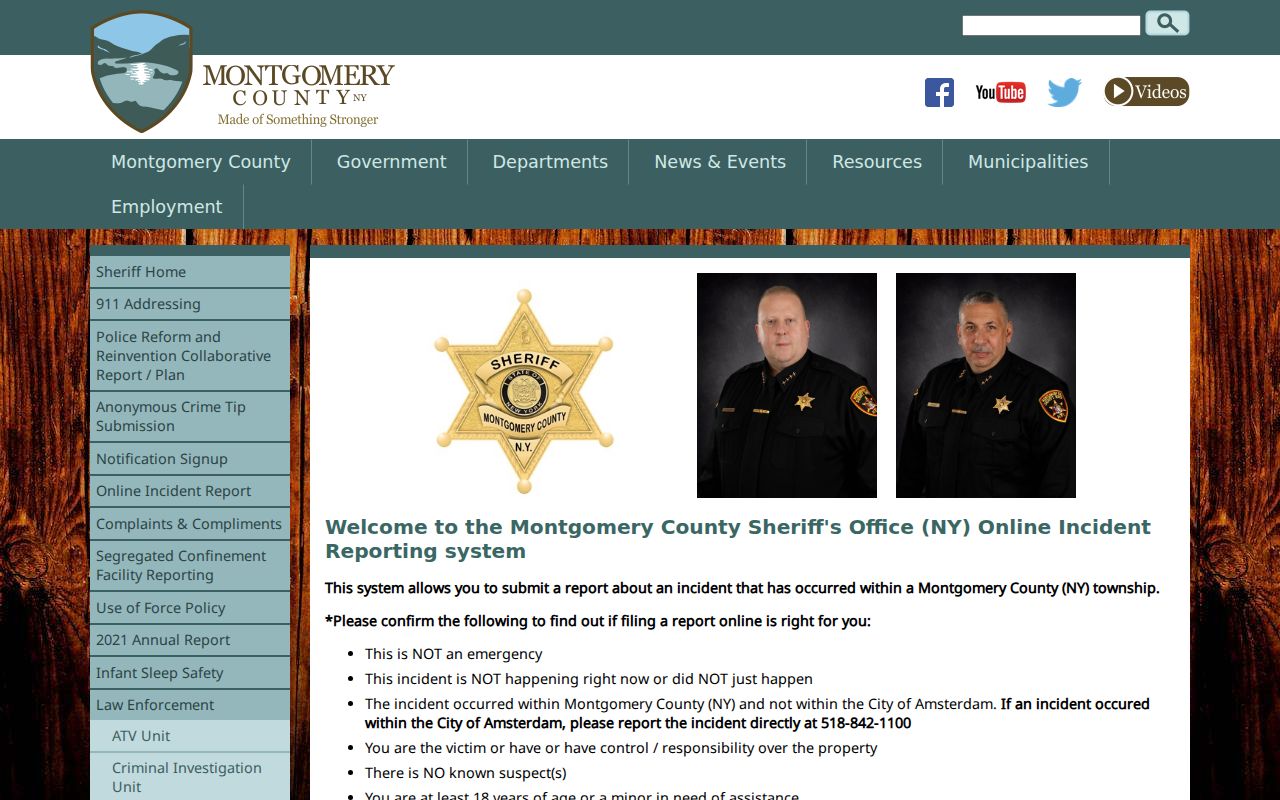
It does not cover every event. City of Amsterdam incidents, emergencies, events in progress, and incidents involving a known suspect must go through the appropriate live police channel.
FOIL does not promise release of every page. An agency may withhold or redact material when disclosure would invade privacy, harm a fair trial, interfere with an investigation, reveal a confidential source or technique, endanger someone, or expose a sealed or juvenile matter. The Sheriff can only answer for records it has.
Public Access Laws in New York
New York separates agency access, court access, and repository access. FOIL covers executive-agency records unless an exemption applies. Court clerks follow Judiciary Law and court rules when searching files and certifying copies. DCJS criminal-history records are confidential and do not become public merely because a FOIL request asks for them. Registry disclosure follows a separate statute.
Key statutes:
Public Officers Law Article 6 gives access to agency records subject to statutory exemptions.
Public Officers Law §87(2) permits withholding for privacy, law-enforcement, source, and safety concerns.
Executive Law §837 sets DCJS criminal-history and authorized dissemination duties.
Judiciary Law §255 directs clerks to search and certify lawful court-record requests upon payment.
Correction Law Article 6-C governs the sex offender registry and public notification.
Send an incident-report request to the agency that made the report. Ask a clerk for filed case documents. Use DCJS Personal Record Review only for your own repository history. These boundaries avoid delays and keep each request with the legal custodian.
Montgomery County Warrant Checks
No verified public, name-searchable Montgomery County Sheriff warrant database was found. An arrest warrant may be executed by the Sheriff, but a bench warrant stays tied to the city, town, village, or County Court that issued it. WebCrims can show a scheduled matter. It is not advertised as a complete warrant search.
For your own possible warrant, identify the court and docket from the appearance ticket or prior papers. Use the official local-court directory for a missed local appearance, or call County Court at 518-853-3834 for a County Court case. Sheriff dispatch at 518-853-5500 can give safe procedural direction. Legal advice may be wise before appearing in person. After the court recalls or satisfies a warrant, keep the order and confirm the court system was updated.
Do not confront or try to detain anyone. Unexecuted search warrants, sealed indictments, juvenile warrants, confidential addresses, and material that could impede enforcement may not be released.
Sealed, Expunged, and Restricted Records
Record sealing is New York's main remedy. CPL 160.50 generally seals favorable terminations, CPL 160.55 addresses specified violation outcomes, CPL 160.58 covers certain treatment-related matters, and CPL 160.59 allows an application to seal up to two eligible convictions after the statutory ten-year period. Youthful-offender records are confidential. Certain marijuana convictions are expunged by statute.
For CPL 160.59, New York Courts says an applicant may have no more than two convictions in the permitted mix and must meet the waiting period measured from conviction or release from incarceration. Sex offenses, violent felonies, and other listed serious felonies are excluded. The filing starts with a certificate of disposition and goes to the court that entered the eligible conviction. The applicant serves the district attorney, and a judge may decide the papers or hold a hearing.
The Clean Slate Act took effect in 2024 and gives the court system through November 16, 2027 to complete automatic sealing. Eligibility depends on the offense, elapsed time, pending charges, incarceration, and completion of supervision. Sealing limits ordinary public access but does not erase the record for every authorized agency or proceeding.
Montgomery County Record Corrections
A wrong WebCrims entry should go to the specific Montgomery County court because court staff enter and correct the case data. Bring the docket number, the displayed field, and a copy of any disposition or order that supports the correction. The County Clerk can help with a Supreme or County Court file, while the local clerk handles a city, town, or village docket.
For an error in your statewide criminal-history record, request a DCJS Personal Record Review first. The response includes challenge instructions. A certified disposition, sealing order, or other official court document can show what the court reported and help DCJS trace an incomplete or mismatched event. Booking, court, and repository systems may update at different times, so correcting one display does not always correct the others at once.
Note: Keep certified copies of a corrected disposition or sealing order until each relevant Montgomery County and New York system reflects the change.
Montgomery County Record Geography
Fonda's Broadway and Park Street area tells much of the county's record story. The current courthouse handles active County Court work. The 1836 Old Courthouse at 9 Park Street now houses the Department of History and Archives, whose non-circulating library supports historical and genealogical research by appointment. It is a rich archive, but it is not the counter for a current criminal file. The Public Defender also works from the Old Courthouse.
Fultonville holds the modern Sheriff and correctional complex. Amsterdam maintains its own police department and City Court. Ten towns and several villages add more local courts. That geography explains why a broad Montgomery County criminal record request can fail: the requester must follow the agency and court that created the document.
The county's ATI Community Service Program also works across all 18 courts. Judges may order unpaid service through approved public or nonprofit sites as a sentence or condition. ATI screens placements, tracks completion, and reports a failure back to the sentencing court. Those court orders and reports are not the same thing as a sheriff arrest record.
Montgomery County Criminal Records by City
Amsterdam, Canajoharie, and Fort Plain have distinct local record routes. Amsterdam Police uses city forms and its own records channel, while Amsterdam City Court and Amsterdam Town Court are separate. Canajoharie has both Village Court and Town Court at different counters. Fort Plain police reports stay with the village, but local criminal cases are directed to Minden Town Court. Each local page follows that city or village before routing custody and felony records into the county system.
Amsterdam Criminal Records
Population 18,219 · City police, city FOIL, and City Court channels
Canajoharie Criminal Records
Population 3,660 · Village police plus separate village and town courts
Fort Plain Criminal Records
Population 1,930 · Village police records and Minden Town Court files
Montgomery County Fingerprint Record Route
New York residents use IdentoGO by IDEMIA to submit fingerprints for DCJS Personal Record Review. Service code 15464Z requests a suppressed record; 15465F requests an unsuppressed record. Make an appointment through IdentoGO enrollment or call 877-472-6915. Bring an accepted form of identification. DCJS states that results are mailed and lists a three-to-four-week processing period, with no pickup option.
The IdentoGO location page helps Montgomery County residents find an enrollment site.

The appointment captures fingerprints for identity matching. It is not a public name lookup or a way to order another person's DCJS record.
Applicants who cannot afford the processing charge may request a DCJS fee-waiver packet. DCJS also provides phone and email help and sends challenge instructions with the response. A separate submission is required if both suppressed and unsuppressed versions are wanted.