
Montgomery County Criminal Court Cases
Montgomery County Court has exclusive trial jurisdiction over felony prosecutions and may also hear misdemeanors. It sits at 58 Broadway in Fonda. The County Clerk supports the Supreme and County Court files, copies, and certifications. Local criminal work is spread among 18 courts, including Amsterdam City Court and town or village courts across Montgomery County. Those local courts hear misdemeanors and violations and conduct preliminary steps in felony cases. A charge that began in a town court can later appear in County Court after indictment or another superior-court filing.
The court clerk, not the arresting agency, keeps the judicial case file. That distinction matters. A police report describes the enforcement event, while a court docket records the prosecution after filing. Court papers can include an accusatory instrument, motions, orders, plea entries, a disposition, and sentencing records. Use the arrest location and the court named on an appearance ticket or other paperwork to identify the first clerk. The official Montgomery County court directory is the best current source for justice-court contacts, sessions, and clerk hours.
Montgomery County's 18-Court Split
A county name alone does not identify the right file room. Montgomery County lists town courts for Amsterdam, Canajoharie, Charleston, Florida, Glen, Minden, Mohawk, Palatine, and Root. It also has Amsterdam City Court, Canajoharie Village Court, and the combined Town and Village Court of St. Johnsville. Each local clerk controls the records created in that court. Current assignments and schedules can change, so the live county directory is safer than an old judge or clerk listing.
For example, Amsterdam City Court and the Town of Amsterdam Court are different offices. The Town Court is at 283 Manny's Corners Road and publishes 518-842-7411, while city matters use the City Court channel. A Canajoharie-area case may belong to the town court or village court. Read the court name on the docket or accusatory instrument exactly. If the matter is a felony now pending in Montgomery County Court, call that court at 518-853-3834. For copies or certification, the County Clerk can be reached at 518-853-8111.
Searching Montgomery County Case Records
New York WebCrims is the practical online starting point for selected criminal cases and future court appearances. It is free, but its result is a calendar and case-status view rather than a certified Montgomery County court file. Search by a defendant name when the docket number is unknown. Use the case-identifier mode when a docket or indictment number is available, since that is usually more precise.
- Open WebCrims and choose defendant, case identifier, or criminal court calendar search.
- Enter the name or preserve the exact punctuation and leading zeroes in the case number.
- Confirm that the result names the expected Montgomery County court and matches known dates.
- Read the charge, status, next appearance, and calendar part as clues, not as the whole file.
- Contact the named clerk to request filed documents, a certificate of disposition, or a certified copy.
The fields differ by search mode. A blank result can reflect timing, spelling, sealing, a closed case, or a court outside the portal's selected coverage.
| Search field | Type | Required | Practical use |
|---|---|---|---|
| Defendant Name | Text | Name mode | Verify common names against court and date details. |
| Case or Docket Number | Text | Identifier mode | Keep punctuation and leading zeroes shown by the court. |
| Court | Dropdown | Calendar mode | Select the precise county, city, town, or village court. |
| Date | Date | Calendar mode | Use the date tied to the criminal court calendar. |
| Search or Clear | Button | No | Run the query or reset the entered criteria. |
WebCrims Is Not a Case File
WebCrims can show a defendant name, court, docket or indictment number, charge text, statutory citation, case status, counsel information, next appearance, and calendar part. It does not promise the complaint, indictment, motion papers, grand-jury material, police report, fingerprints, or a full sentence calculation. It also is not the fingerprint-supported record maintained by the New York State Division of Criminal Justice Services.
The clerk provides the stronger source when a reader needs the filed paper, proof of outcome, or a certified record. Ask whether the Montgomery County file is public, onsite, archived, or subject to advance retrieval. Also ask for the current plain-copy and certified-copy charge because the research did not locate a reliable local fee schedule. New York Courts says individual court staff enter and correct eCourts information. If an online entry looks wrong, contact the court that created it rather than the Sheriff or the portal vendor.
The Office of Court Administration Criminal History Record Search is a separate paid court-record search. It still is not a DCJS rap sheet. Readers reviewing their own fingerprint-supported statewide history should use DCJS Personal Record Review instead.
Inside a Montgomery County Case File
A Montgomery County court file follows the filed prosecution, not just the arrest. Start with the case number and court, then compare the initial charge with later docket entries. The final outcome may differ from the allegation at arrest. A disposition states the present or final result for a charge. A certificate of disposition is the clerk-certified statement often requested when formal proof of the result is needed.
| Case Number and Court | Identifies the docket and the clerk responsible for the Montgomery County file. |
|---|---|
| Charging Document | The complaint, information, or indictment that starts or supports the prosecution. |
| Docket Entries | A dated record of appearances, filings, motions, orders, pleas, and other case events. |
| Hearing Dates | Past appearances and, when available, the next scheduled court date and part. |
| Disposition and Judgment | Dismissal, acquittal, guilty plea, verdict, or another recorded outcome. |
| Sentence and Conditions | Jail or prison, probation, fine, surcharge, restitution, or other terms if imposed. |
Protected account numbers and similar identifiers may be redacted. Sealed, juvenile, and youthful-offender records do not appear through ordinary public access.
Montgomery County Clerk Copy Routes
For a felony file, begin with Montgomery County Court at 58 Broadway, P.O. Box 1500, Fonda, NY 12068. The court line is 518-853-3834. The County Clerk, reached at 518-853-8111, handles filed records, copies, and certifications for Supreme and County Court. A local misdemeanor stays with its city, town, or village clerk unless later court action moves the felony prosecution to the county level.
Describe the document and case with care. Give the exact docket or indictment number when known, the defendant name, the court, and an approximate date. Ask whether inspection is possible and whether the file must be pulled from an archive. For historical context rather than a live judicial file, Montgomery County's Department of History and Archives uses the 1836 Old Courthouse and offers research access by appointment. That archive does not replace the current clerk for an active prosecution or a certified disposition.
Montgomery County Court
58 Broadway
P.O. Box 1500
Fonda, NY 12068
518-853-3834
County Clerk
Supreme and County Court records
Fonda county complex
518-853-8111
How a Criminal Case Moves
A Montgomery County prosecution can start with an arrest or appearance ticket and arraignment in a local court. A felony complaint may then proceed through local preliminary steps and grand-jury review. An indictment or superior-court information brings the felony charge into County Court, followed by another arraignment, discovery, motions, a plea or trial, disposition, and sentence. An appeal may follow. Not every case reaches each stage.
Case flow: Charges Filed › Arraignment › Pretrial › Plea or Trial › Disposition › Sentencing
The wording at each point matters. An arrest charge is an allegation. A filed charge is what the prosecutor brings before the court. A plea offense may differ from both. “Dismissed” means the charge ended without a conviction on that charge. “Acquitted” follows a not-guilty finding, while a guilty plea or verdict precedes sentence. Reading only the first entry can give a false view of the Montgomery County case outcome.
Reading Montgomery County Case Outcomes
New York court terms condense major events into short labels. Match the docket entry to the final disposition and sentence. Do not treat a future appearance as a result, or a charge as proof of guilt. A certificate from the clerk is more useful than a portal screen when the outcome must be documented.
- Accusatory instrument
- A complaint, information, or indictment that begins or supports the case.
- Arraignment
- The appearance when charges are addressed and a plea may be entered.
- Disposition
- The final or current result recorded for a charge or case.
- Adjournment in contemplation of dismissal
- A postponement that leads to dismissal and sealing if statutory conditions are met.
- Bench warrant
- A court order issued after a failure to appear or comply.
Specialty pathways also leave their own docket trail. The Montgomery County Public Defender lists Drug Court and Integrated Domestic Violence Court among its criminal representation work. The county's ATI Community Service Program serves all 18 courts. A judge sets the hours and completion period, ATI assigns and tracks the placement, and a violation returns to court for possible resentencing.
Montgomery County Court or Sheriff?
A Sheriff record request cannot replace a court request. The Montgomery County Sheriff's Office may hold its own incident or arrest report. It does not become custodian of motions, judicial orders, pleas, or the clerk's docket merely because deputies made the arrest or Corrections booked the person. New York FOIL applies to executive-agency records, subject to exemptions. Judiciary files follow court-access rules and Judiciary Law instead.
Use the office that created the record. Send a focused request to the Sheriff for a sheriff-created report. Ask the court clerk for the accusatory instrument, disposition, or certified case document. If a portal result and clerk record conflict, the specific Montgomery County court is the correction point. A broader explanation of how arrest and court files differ is available in the Montgomery County arrest lookup.
Note: A case search and a fingerprint-based DCJS Personal Record Review answer different questions and should not be treated as interchangeable.
Case Record Access & Restrictions
Public access has firm limits. New York Public Officers Law Article 6 provides FOIL access to agency records unless an exemption applies, but the judiciary is not an agency under FOIL. Judiciary Law §255 directs clerks to search and certify court records upon lawful request and payment, subject to confidentiality and sealing rules. This is why Montgomery County searchers should route police documents to the agency and filed criminal papers to the clerk.
Sealed cases, juvenile matters, and youthful-offender adjudications are restricted from ordinary public access. Clerk copies may also redact Social Security numbers, financial account details, victim data, and other protected information. A missing WebCrims result does not prove that a case never existed. It may be sealed, closed, new, off-calendar, indexed under another spelling, or held in a local system. Call the proper Montgomery County clerk and ask whether a public file exists.
The official text of Judiciary Law §255 describes clerk search and certification duties. The FOIL exemptions in Public Officers Law §87 can permit withholding when disclosure would harm an investigation, invade privacy, reveal a confidential source, or create a safety risk. Neither law opens a sealed record.
The Office of Court Administration CHRS page provides the only manifest-assigned image for this record page. Its source explains that the statewide name search is a court-record product, not the Montgomery County clerk's full file.
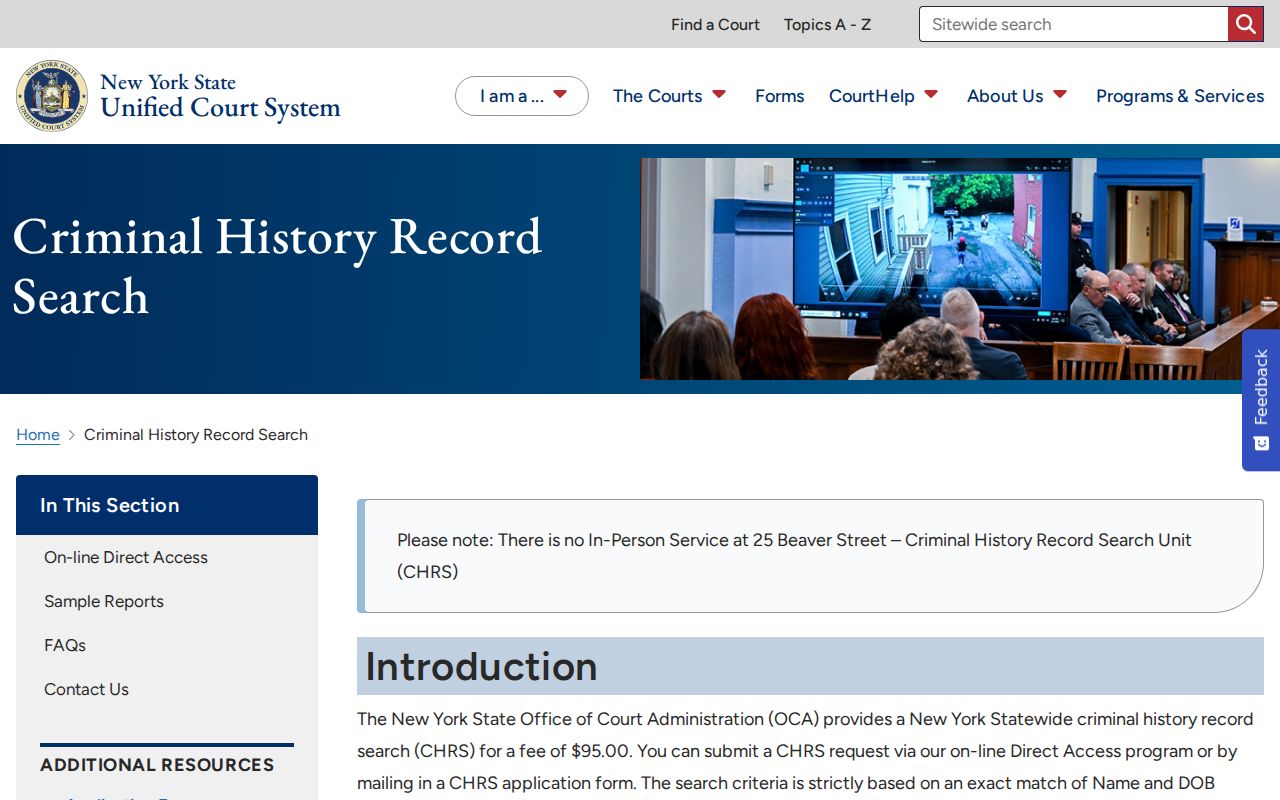
The image reinforces the key boundary: confirm any search response with the court that maintains the original Montgomery County record.