
Sex Offender Checks in Montgomery County
The New York State Division of Criminal Justice Services, known as DCJS, maintains the New York State Sex Offender Registry. Its public web directory is the main starting point for Montgomery County Level 2 and Level 3 records. Searchers can filter the directory by county instead of guessing a town or ZIP code. That matters in a county where a listed residence may be in Amsterdam, a village, or a rural postal area.
The directory is not a full list of every person who must register. Level 1 information follows a telephone process. Some older Level 2 or Level 3 records may also be absent because of the due-process limit described by DCJS. A useful Montgomery County check therefore pairs the web search with the phone channel when the search concerns a known person and the required identifier is available.
The official DCJS registry overview shows the state's public tools and explains their roles. The accompanying registry image helps identify the government source before a search begins.
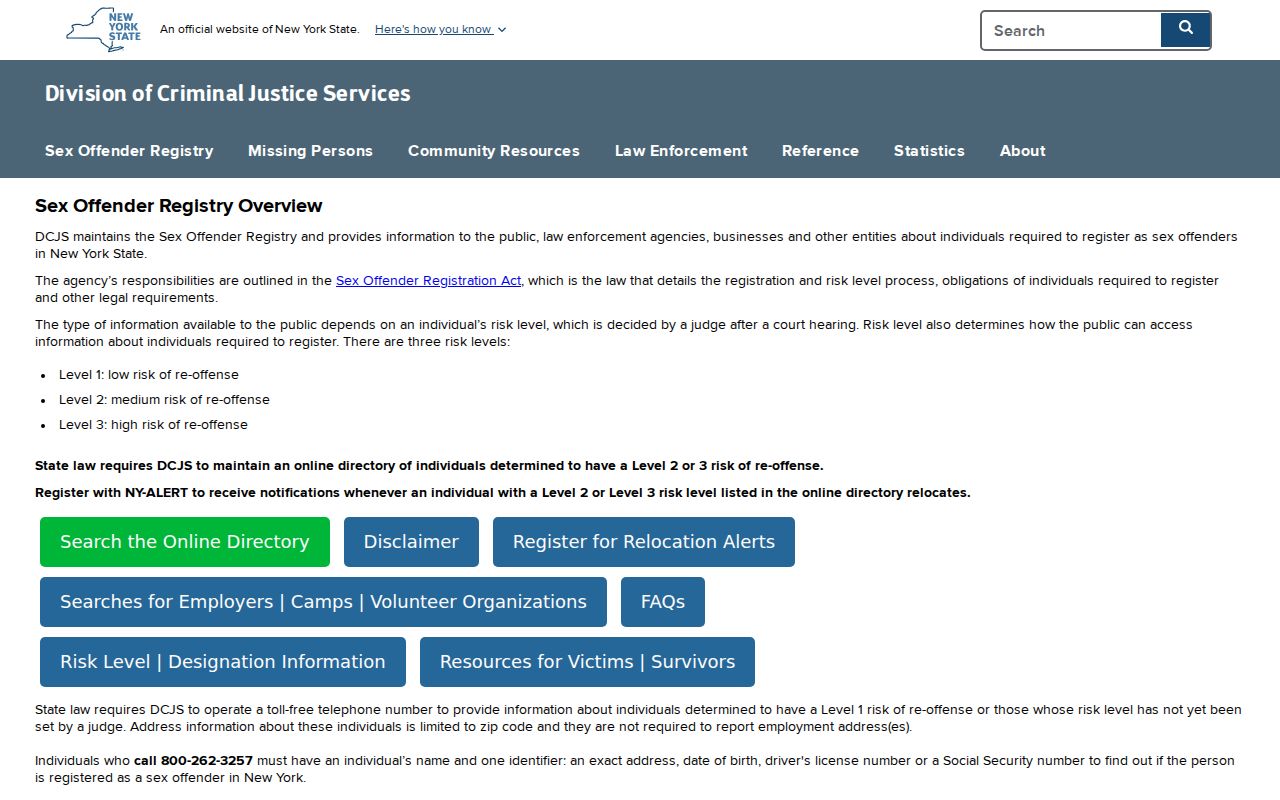
Using that state page keeps the inquiry tied to the agency that administers New York registration records.
Montgomery County Level 1 Registry Checks
A blank online result does not rule out Level 1 registration. New York does not publish Level 1 profiles in the online public directory. For a person-specific inquiry, call the registry at 1-800-262-3257, choose option 2, or call 518-457-5837. The caller must give the person's name and one qualifying identifier: an exact address, full date of birth, driver's-license number, or Social Security number.
This phone route is narrow by design. It is not a general Montgomery County list, and the online county filter cannot replace it. Use only identifiers you are lawfully entitled to provide. If the person cannot be confirmed, do not treat the lack of a match as proof of no registration history.
Note: Online silence may reflect Level 1 status, an older-record limit, or a search mismatch rather than the absence of registration.
How to Search the New York State Sex Offender Registry
The official public directory accepts one of three search keys. A county search is best for community awareness across Montgomery County. A last-name search is better when the person is known, while a ZIP search narrows the results to one postal area. The result set covers public Level 2 and Level 3 profiles.
- Open the DCJS public directory and review the conditions placed on registry use.
- Choose one key: enter a last name, select Montgomery from the county list, or enter a five-digit ZIP code.
- Run the search and compare the public result list carefully. Do not assume similar names identify the same person.
- Open the matching profile and read the risk level, designation, residence disclosure, offense details, and registration status together.
| Field Label | Type | Required | Notes |
|---|---|---|---|
| Last Name | Text | One search key | Searches by surname |
| County | Dropdown | One search key | Select Montgomery for county-wide Level 2 and Level 3 results |
| ZIP Code | Text | One search key | Accepts a five-digit ZIP code |
| Search | Button | No | Runs the selected query |
The official search interface appears in the accompanying capture. Its limited fields make clear why county, surname, and ZIP searches answer different questions.
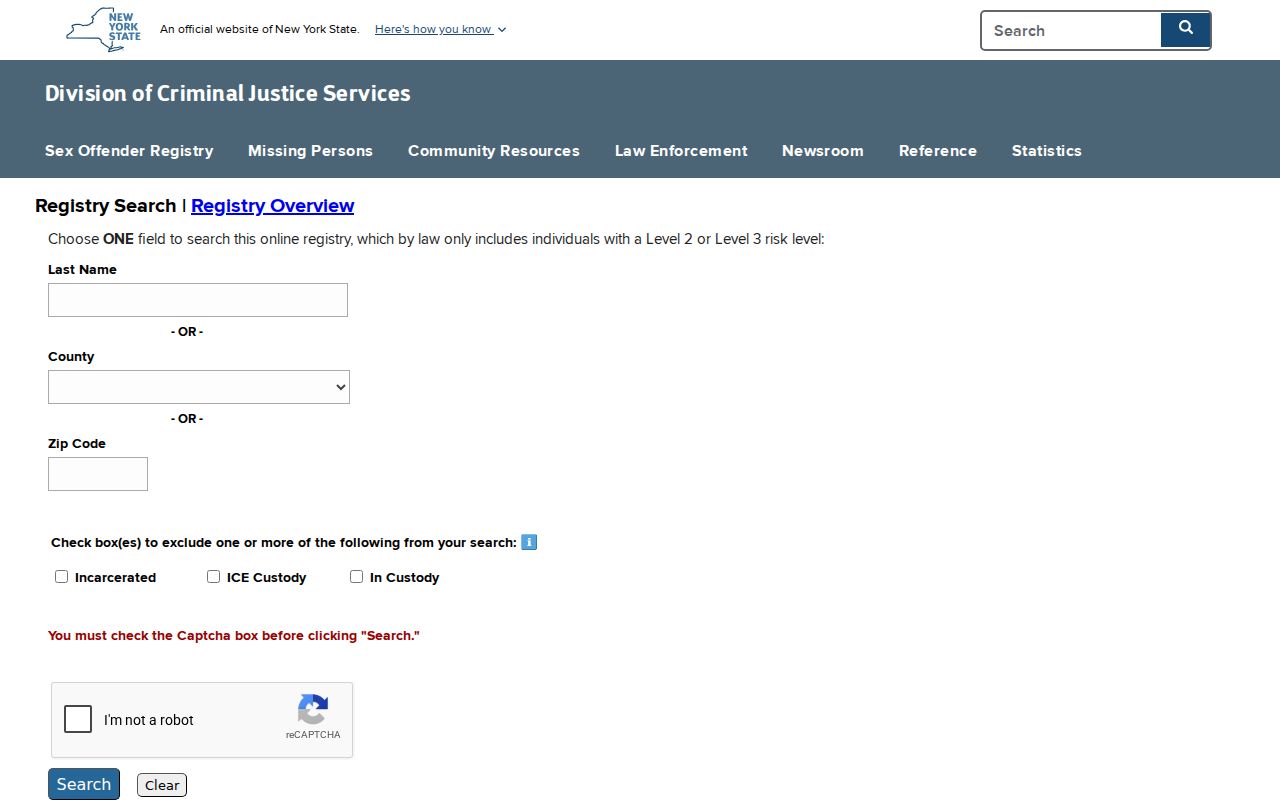
A second search key may catch a spelling or geography issue, but it does not expand the directory to Level 1 records.
Montgomery County Registry e-Alerts
DCJS also offers an e-Alert service for location-based notice. A subscriber may register up to three New York locations. The system can send an email, text, fax, or telephone message when a Level 2 or Level 3 registrant reports an address within the chosen area. A household can use separate locations for home, a relative's home, or another place tied to personal safety.
An alert is a notice of reported registry information, not proof of new misconduct. Open the official profile, confirm the reported facts, and use calm safety planning. For a suspected breach of registration duties in Montgomery County, give specific facts to the Sheriff's Office. Call 911 only for an immediate threat.
The location limit makes careful setup useful. Choose the three places that matter most rather than entering small variations of the same address. Delivery by text or email can fit daily use, while telephone or fax may suit a household with different access needs. A notice only covers a Level 2 or Level 3 address reported within the selected area. It cannot announce a Level 1 record that is excluded from the web directory, and it cannot confirm where a person is at a given moment. Recheck the official profile whenever an alert arrives, since the profile supplies the identity and classification details needed to understand the notice.
Inside a Registry Profile
A public Level 2 or Level 3 profile joins identity, classification, residence, and offense details in one record. It is not an arrest report, a court case file, or a full DCJS rap sheet. Those records may cover later case events or other charges that the registry profile was never meant to show.
| Name & Aliases | The registered name and aliases reported in the public record |
|---|---|
| Photo & Description | A photograph and physical description used to help identify the registrant |
| Residence | Complete address for Level 2 and Level 3 profiles; Level 1 telephone disclosure is limited to ZIP code |
| Qualifying Offense | Information about the offense that created the registration duty |
| Risk & Designation | The judicial risk level and any separate statutory designation |
| Registration Status | The registration information DCJS makes public for the profile |
Read each field as of the date shown by the source. Residence data can change, and the level is a court finding about risk rather than a new criminal charge.
Montgomery County Registry Address Disclosure
New York changes the amount of residence detail by level. Public Level 2 and Level 3 profiles can provide a complete residence address. A Level 1 telephone inquiry supplies ZIP-code residence information, not a full street address. That split is one reason an online map or county list cannot stand in for the statutory phone channel.
Searchers should also separate a risk level from a designation. Level 1, Level 2, and Level 3 describe the court's risk finding. Sexual predator, sexually violent offender, and predicate sex offender are separate court-assigned designations. A designation can require lifetime registration even when the risk finding is Level 1.
New York Registration Levels and Requirements
A judge assigns the risk level after a hearing. For a person leaving prison, the Board of Examiners of Sex Offenders recommends a level, but the court makes the final decision. SORA also requires yearly address verification and written notice to DCJS within ten days after a move. Local law enforcement verifies Level 3 addresses every 90 days and Level 1 or Level 2 addresses once a year.
| Risk or Designation | Meaning | Duration |
|---|---|---|
| Level 1, no designation | Low risk of repeat offense | 20 years |
| Level 2, no designation | Moderate risk | Life; petition may be available after 30 years under Correction Law §168-o |
| Level 3, no designation | High risk and public-safety threat | Life |
| Any level with a listed designation | Sexual predator, sexually violent offender, or predicate sex offender | Life |
The DCJS registry FAQ gives the state rules behind these levels and duties. The accompanying official resource is useful when a profile term needs to be checked against current agency guidance.
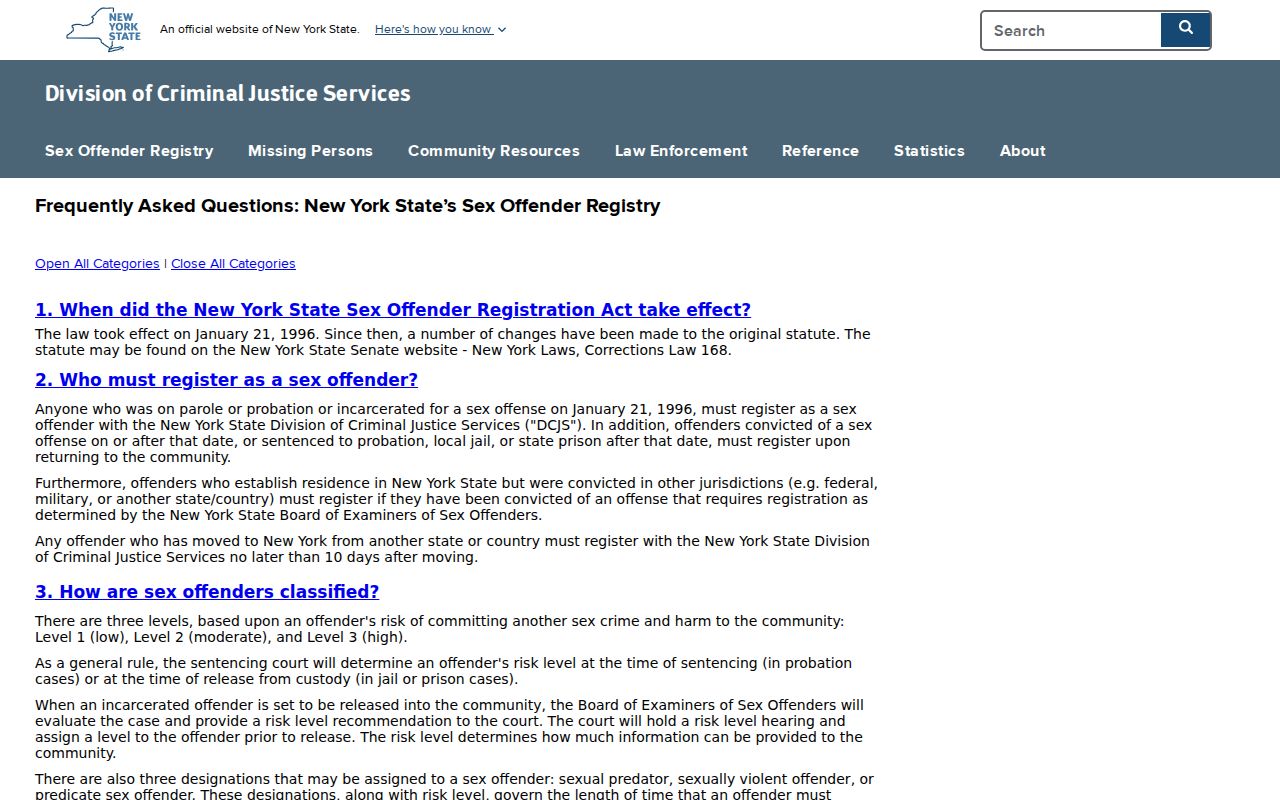
Duration and public visibility are related, but they are not the same rule. Read both the level and any designation.
Montgomery County Cross-State Registry Searches
A Montgomery County search can miss registration held by another jurisdiction. The U.S. Department of Justice operates the National Sex Offender Public Website, or NSOPW, as a combined search across participating states, territories, tribal jurisdictions, and the District of Columbia. It supplements New York's directory when a person has lived or registered elsewhere.
NSOPW does not replace the New York telephone inquiry for Level 1 information. Use the national layer for cross-border scope, then return to DCJS for New York-specific disclosure rules. The accompanying image comes from the official NSOPW portal.
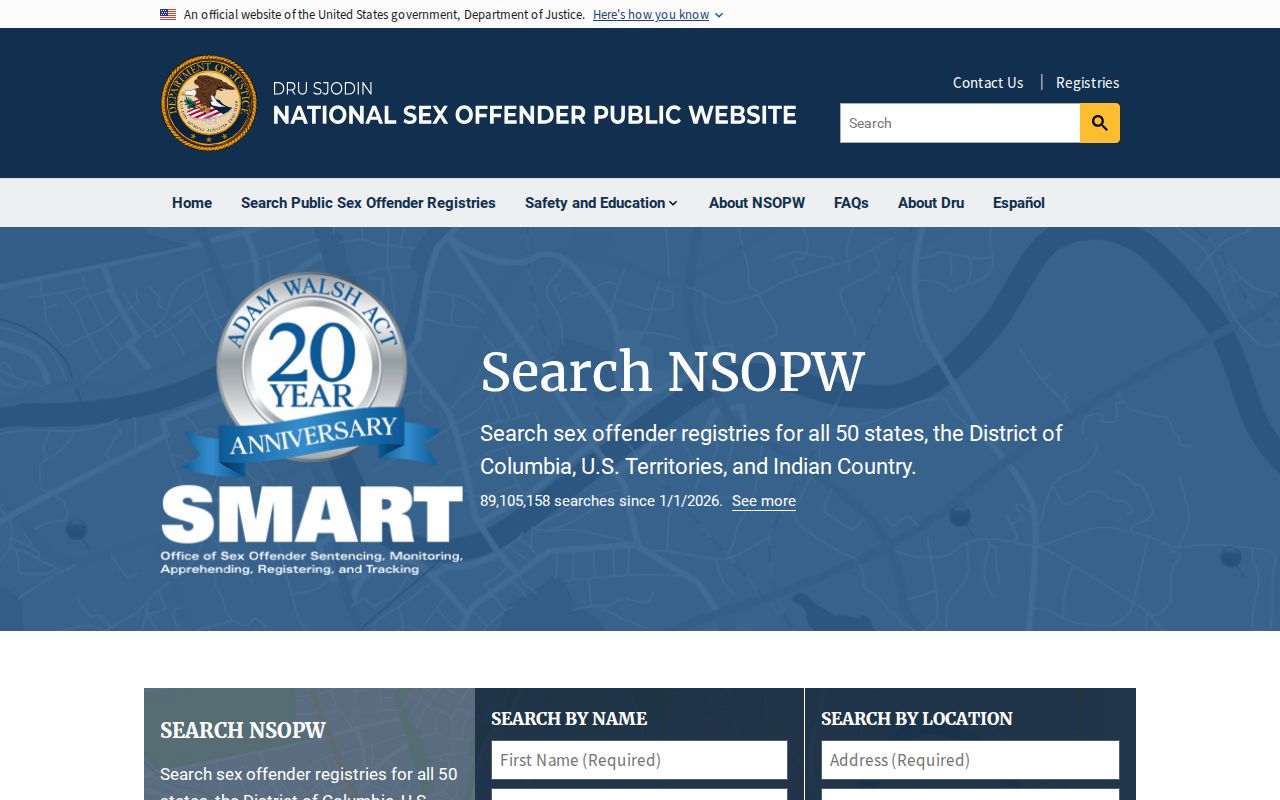
This second official source helps when travel or a past address makes a New York-only search too narrow.
Montgomery County Registry Noncompliance Reports
Suspected noncompliance should go to law enforcement, not to a direct confrontation. The Montgomery County Sheriff's contact channel provides a local route for a non-emergency concern. The official Sheriff website identifies the local agency, while the Montgomery County directory confirms its government contact details. The office is at 200 Clark Drive, Fultonville, NY 12072, and its main number is 518-853-5500. Give the name, location, date, and specific conduct that caused concern.
Registration rules include annual address verification and notice to DCJS no later than ten days after moving. A member of the public should report facts, not decide that a violation occurred. Immediate danger belongs with 911. A profile question or a Level 1 inquiry belongs with DCJS, while a local safety or compliance report belongs with the appropriate police agency.
Note: Preserve what you observed and when, then let trained officers compare those facts with the official registration record.
Community Notification and Lawful Use
The registry exists to support public awareness and safety planning. It should be read with care. A listed offense and a risk finding are official facts, but they do not authorize threats, intimidation, or private enforcement. Use alerts to review household plans, confirm an address through official channels, and share concerns with law enforcement.
Correction Law Article 6-C creates New York's SORA framework, including its public-notification and misuse rules. The statutory system controls what appears online, what can be obtained by telephone, and how officials verify residence information.
Use registry records lawfully: Misusing registry information to harass, intimidate, or threaten a registrant or family can be a crime under New York law. Report concerns to law enforcement instead.